fivemack: (Default)
Hello all.

I answered a few questions on the live teleconference link this afternoon, but afterwards I was quickly abducted by Tobes and offered cider that I couldn't refuse. I'm accessing the web from my phone and I can't use Flash so I can't use the ustream chat. If you have any more questions, please ask them here.
fivemack: (Default)
Ah, this is the life. I am sitting in a perfect glass-and-white-steel cafe on the Belem seafront, sipping lemonade, eating what appears to be seaweed soup, and looking out at the green hills across the Teju. I've just visited the Geronimo Monastery, whose carved-marble cloisters are of more than Mughal absurd intricacy, and whose upper room contains a marvellous polycultural timeline of the world, the monastery and Portugal.

Lisbon is a city built on hills, and therefore a city of panoramas: I'll have several dozen megabytes of photos to feed to Hugin when I get home.

If only I were better at convincing my friends to accompany me to far cities ...
fivemack: (Default)
For the last several months, I've offered some disc space and some compute cycles on one of my computers to [livejournal.com profile] pseudomonas for developing thesciencebehindit.net, a site which uses some very fancy natural language processing to attempt to work out from which scientific paper an article in the popular press was written.

Today, the site was mentioned on badscience.net.

This evening, I noticed that the computer had dropped off the Internet, and that the air in the study smelt of that magic smoke that electronic components emit as they fail. I happened to have a spare power supply, and with this replaced, and the fuse in the power supply changed, the computer started working again.

The dead component was a Colorsit EN60950 Switching Power Supply; I think it's quite ancient, it may well have come out of a computer bought at the office in 2004 to be plugged into a case that I bought in 2007. Maybe five years is a reasonable innings for a power supply ... the last one that I had fail did so after six months.

To the pub now, I think, leaving for tomorrow the question of why compute node #2, which yesterday was happily transferring tens of gigabytes around by NFS, today denies having an ethernet interface.
fivemack: (Default)
Suppose, lunatic that I am, that I wish to leave the comfortable safety of FCSC-insured cash ISAs and head, rather than to the flaming whirlpool that is the UK equity market, to the choppy waters of index-linked UK gilts, where my money is at least wrapped in Her Majesty's third-best ermine mantle against the unknown possibilities of inflation.

A neophyte attempts to figure out what information sources are telling him )
fivemack: (Default)
Intel has announced the instruction set for its new vector-supercomputer-disguised-as-a-graphics-card 'Larrabee'.

http://software.intel.com/en-us/articles/prototype-primitives-guide/ has a C++ implementation using the data types and intrinsic names which the real thing will use.

It has a full set of the instructions you would expect, including count-set-bits and find-first-set-bit; it has vector gather and scatter (finally!), it has the normal-for-Intel irritating omissions (add-with-carry for 32-bit numbers only?), and it has one or two really quite surprising instructions:


BITINTERLEAVE21_PI - 2:1 Bit-Interleave Int32 Vectors

Performs an element-by-element bitwise interleave, using a 2:1 pattern, between int32 vector v2 and int32 vector v3. The low 21 bits from elements in v2 are interleaved with the low 11 bits from elements in v3 to form a vector of 32-bit values. Bits alternate 2:1, so that source elements A and B combine bitwise this way (high to low):
A20 B10 A19 A18 B9 A17 A16 B8 … A5 A4 B2 A3 A2 B1 A1 A0 B0


I will buy a chocolate pudding at the Carlton next Thursday for the person to give the least ludicrously contrived example in which this instruction might be useful. There is also a BITINTERLEAVE11_PI which takes alternate bits from the two source elements.
fivemack: (Default)
I found, lying around in a pile in my study, a wallet which I must have picked up at a trade show in a past life. It's got the Ministry of Defence logo on the front: eagle in front of crossed swords in front of anchor. I wonder how many committee meetings it took to agree on that order, and how senior the attending major-generals, air vice-marshals and rear-admirals were.

It is commendably thin and light, and has a convenient coin purse. However, it is capable of holding precisely one bank card.
fivemack: (Default)
Should you ever find yourself in the 15th Arrondisement of Paris, go to metro 'Pasteur' on boulevard Pasteur, and follow the signs down Rue de Docteur Roux (a collaborator of Pasteur's) to the Institute Pasteur, on whose grounds is the Pasteur Museum. You need to bring a passport to get through the institute's security; the French for anti-terrorism is, wonderfully, 'vigi-pirates'.

I hadn't realised quite how much of early microbiology was done by Pasteur. Starting in 1849, he discovered chiral compounds, disproved spontaneous generation, figured out (to France's great economic advantage) the mechanisms of fermentation for wine and beer, saved the Languedoc silk industry (I was until today unaware that Languedoc had ever had a silk industry), and also discovered the attenuation method of making vaccines and applied it to chicken cholera, anthrax and (using live rabbits as the culture medium) rabies. The equipment with which he made these discoveries is all on display in one room in the Pasteur Museum (open 1400-1730 Monday-Friday, entrance €4, closed August), which is otherwise the apartment in which he spent the last years of his life; there is a good eight-page tour guide in English

Pasteur is buried in a crypt in the basement of the Pasteur Museum.

And this is a crypt and a half, probably even a crypt and three quarters; definitely worth the visit even if you happen to be in some other part of Paris. It's fin-de-siecle decadence at the heaviest and most incense-saturated* level. Art Nouveau motifs - friezes of chickens, mulberry leaves with their silkworms, mad dogs and very unhappy-looking rabbits, garlands of hops and grapes to reflect the fermentation discoveries - all done in a Byzantine style of domes, decorated in mosaic front to back and floor to ceiling with the ceilings done in gold, and with much more obviously Byzantine and explicitly Catholic crucifixes and alpha-omega motifs on the three-part dome above the altar at the back of the crypt.

* only metaphorical incense, no actual censers present

Blast!

Mar. 17th, 2009 07:19 pm
fivemack: (Default)
I am in south-west Paris. My wallet isn't. At least I still have my phone, which would be much more tedious to lose.

I've cancelled four bank cards and wonder why I habitually carry four bank cards. Will live off the company credit card until Friday.
fivemack: (Default)
These are the light curves, between February and April 2007, of the hundred Corot stars for which the 99th percentile brightness and the 1st percentile brightness differ by the largest multiple of the 1st percentile brightness - IE, the most variable ones.

You can see pairs of stars which whirl around one another in eight or nine hours (these look like thick lines, eg the fourth curve, and if there seems to be a condensation within the curve that's where the fainter star passes behind the brighter), and stars in whose old age the convection cells are stirred to brightness over a period of months (eg the 18th curve).

I don't know whether the stars that suddenly (and it is suddenly - each measurement is over an eight-minute period) appear to change brightness stepwise are showing some subtle feature of the instrumentation which requires handling in the data reduction, or are showing thermonuclear explosions in the accretion discs around white dwarves.

This represents about 1% of the smallest of the released Corot datasets, or more deliberate measurements of star brightnesses than every amateur astronomer on Earth since the invention of the telescope. Kepler, launched a few days ago, will look at thirty times as many stars at about the same sampling rate and for ten times as long.

None of these stars is bright enough to see with the naked eye.

Lightcurves ahoy! (100 medium pictures; click for bigger ones) )
fivemack: (Default)
It may well be that this data release was not thoroughly announced because the population of amateur asteroseismologists is zero, but

http://idc-corotn2-public.ias.u-psud.fr/invoquerSva.do?sva=browseGraph

has light-curve data from several chunks of the Corot planet-hunting and asteroseismology mission.

This is one of those annoying missions which is looking for exciting objects, and has many probable detections, each of which requires half a dozen observations on well-spaced nights from incredibly oversubscribed large telescopes to confirm; the Corot team has only announced confirmed discoveries, but there are probably a fair number of unannounced planets sitting in the dataset.

Yes, the big data set is 14GB long compressed, but there must be somebody who'd prefer the potential of fifty undiscovered planets to six downloaded HDTV movies.
fivemack: (Default)
BOGGLE! at the fabled Marmite and Cheese Pancake

QUAIL! at the Pancake With Creamy Mushroom

CONSUME! the Tomato and Bacon Pancake

IGNITE! the Sugar and Flaming Calvados Pancake (bring your own calvados; works with most strong spirits, slivovitz might be fantastic, whisky probably not)

HELP! fivemack make even more pancakes

TELL! me if you'd like to come (mail tom@womack.net or comment here), so that I avoid either running out of eggs or being obliged to have six-egg omelettes for breakfast for the next week.

I don't know dairy-free pancake recipes, but if they can be made with ingredients available at the Nasreen Dar, tell me what's needed and I'll pick it up on Monday.

At my house (mail me if you don't know the address and can't read my friends-locked post http://fivemack.livejournal.com/146799.html with it in), starting 6:30pm, on Shrove Tuesday which is 24 February. There will be pancakes both savoury and sweet (so don't eat first!) and there will be an open fire.
fivemack: (Default)
http://www.bailii.org/ew/cases/EWHC/Comm/2009/254.html
http://www.bailii.org/ew/cases/EWHC/Comm/2008/51.html

So, a crooked valuer declares a building to be worth eleven million pounds; on this evidence, the Cheshire Building Society lends X (with a 0.75% fee) ten and a half million pounds to buy it, followed by another million. X default after repaying £497,000; the building turns out to be worth £625,000. Other bits of reporting make it fairly clear that the crooked valuer convinced X to take out the loan; what's not altogether clear is who X paid the £10,500,000 to.

What can CBS recover? First: the £11,413,750 that they lent (minus the 625,000 current value of the property).

Then, the £2,411,429 interest that the loans that would otherwise have been made with the money would have accumulated over the time since the fraud. OK.

Then, the £50,701 pay that the staff investigating the fraud got. Fine.

When the fraud was reported, people started taking money out of CBS; £15.7 million more was taken out in the months after the fraud was discovered than in the same two months in the previous and following year. CBS was awarded the £11,514 extra interest that they'd had to pay to borrow £15.7 million on the wholesale market rather than from individual retail depositors, and a further £23,028 for the assumed reticence of retail depositors over the six following months. Hmm.

CBS had to renegotiate a 'back-stop facility' which cost them fees of £108k, of which they were allowed to reclaim £74k.

What I don't quite understand is the next part: CBS didn't borrow £15.7 million on the wholesale market, because as a building society they were already at their 40% borrowing limit and weren't allowed to. Which means they were unable to lend what appears to have been £143 million against those deposits, which means they missed out on £7,557,000 that they would have made in profit on those loans, at 0.5% average annual profit margin and for the expected 4.7-year duration of an average CBS mortgage. The judge allowed CBS to recover that £7,557,000!

Moreover, to attract additional funding CBS offered a 12-month bond at 5.11% 'rather than the 5% they were planning'; people bought £108.5 million of this bond, and the extra interest cost CBS £119,366. Startlingly, the judge allowed CBS to claim that, too!

This seems to be a glorious example of judicially approved counting of unhatched chickens; I would be wary of assuming an annual 0.5% profit on £143 million in mortgages made in 2006.

It then emerges that the crooked valuer hasn't any money and the losses have to be borne by his solicitor, at which point everything other than the initial advance and the lost interest on alternate advances is removed from the judgement.
fivemack: (Default)
Here we have a report demonstrating quite how capable the stealth coatings on contemporary missile-carrying submarines are. Despite both vehicles being equipped with (different models of) the finest sonars that THALES can offer, the lead ships of the British and French deterrent fleets, Vanguard and Le Triomphant, collided in the Atlantic on 3rd February.

Nobody killed or injured, both submarines still watertight, though much expensive metal was bent.
fivemack: (Default)

  • Snow is a damp clumpy substance that lies on top of harder ground. Shovels are good at moving such substances. Might it not be sensible to try moving snow with shovels rather than by shuffling over it with innumerable pairs of feet

  • A garden spade has a gently curved bottom. This is excellent for many earth-related reasons, but when shovelling snow with a spade one swiftly discovers why the shovel also exists

  • When shovelling snow with a spade, one must go back to go over the icy lines created at the edge of the curved bit of spade

  • There is nobody so invisible as a man with a spade

  • It takes about ten minutes to clear a square metre of snow. Shovelling slushy snow for forty minutes makes you sweat

  • If you clear a nice path a foot wide through the car-park, most people will walk on the slushy snow around it

fivemack: (Default)
http://news.bbc.co.uk/1/hi/world/asia-pacific/7863290.stm says

'A 2007 commission report said the rate of [birth] defects [in Shanxi province, the centre of China's coal-mining industry] had risen 40% since 2001, from 104.9 per 10,000 births to 145.5 in 2006.'

This figure seemed to need some context, so I wandered over to google, and found

http://www.independent.co.uk/life-style/health-and-wellbeing/health-news/mediterranean-diet-reduces-birth-defects-525272.html

which says

'The French rate of 39.7 babies born with birth defects per 1,000 live births is less than half that in the Sudan, which has the highest rate in the world, at 82 per 1,000 live births. The UK ranks ninth in the table, behind Spain and Italy, with 43.8 affected babies per 1,000 live births'

and cites the March of Dimes, who provide me with

http://www.marchofdimes.com/MOD-Report-PF.pdf

which has a graph across the bottom of pages 9-10 which matches those figures, and has 51.2 defects per 1000 live births for China.

Is it more likely that the Shanxi figure should be per 1000 births, in which case Shanxi is a complete disaster area - sixty thousand babies born with defects a year - or that the Shanxi figures count only the really obvious immediately-visible birth defects and the March of Dimes figures count minor heart problems which require some work to discover?

"a child was born with physical defects every 30 seconds" => 1M per year; China's birth rate is 13.7 / 1000 people / year = 18.2 million per year, which gives a 5.5% figure that matches the March of Dimes.

I've written to the BBC about this and will be interested to hear what they say.
fivemack: (Default)
The Standing Committee of the Politburo of the Chinese Communist Party

NameWent to universityStudied
Hu JintaoTsinghuaHydraulic engineering
Wu BangguoTsinghuaElectron tube engineering
Wen JiabaoBeijing Institute of GeologyPhD in geomechanics
Jia QinglinShijiazhuang Industrial Management School (Hebei, 200km from Beijing)Industrial enterprise planning
Li ChangchunHarbin Institute of TechnologyElectrical engineering
Xi JinpingTsinghuaChemical engineering
Li KeqiangPeking UniversityLLB; PhD in economics
He GuoqiangBeijing Institute of Chemical EngineeringInorganic chemistry
Zhou YongkangBeijing Petroleum InstituteGeophysical survey and exploration


What I don't know is whether there's ever been a US or UK cabinet with this high a concentration of engineers.
fivemack: (Default)
I'm running for TAFF, and I really ought to have mentioned this here already since this is my main point of contact with the world. TAFF is a tradition dating back to a time when the Atlantic was much wider, in which the collected science-fiction fandoms of Europe and America vote for a representative of one to be sent to the other; the voting is at Easter, and the winner is being sent to Canada for the Worldcon this summer. There are two candidates, [livejournal.com profile] stevegreen and myself.

Now, science fiction books. For it is Hugo-nominating season, when everyone planning to go to the Worldcon ought to figure out what the five best SF novels published this year that they've read have been, and the three people* who read new short fiction also get to nominate short fiction at three different lengths. Doing this with any competence as all is a habit costly in both coin and bookcase space, since the 'published' is overwhelmingly 'published in US hardback'.

The pair of books which absolutely jumped out at me this year, and which I've been proselytising enthusastically, is Catherynne Valente's In the Night Garden and In the Cities of Coin and Spice. It's absolutely marvellous in its post-modern tangling and intertwining of beautifully-written plot, stories of monsters told by story-telling monsters, a travelogue to beat all travelogues, a work of imagination comparable to (if obviously strongly inspired by) the Arabian Nights, everyone should read it as soon as they can, and it's published in 2006 so irrelevant for this year's Hugo.

SF is a literature of series; it's a lot of work to invent a world, you might as well set several books there, and for a literature read significantly by people capable of reading at ridiculous pace, eighteen-month publication gaps may be the only way to assure pacing. Which means there are a lot of excellent novels which it doesn't make great sense to nominate as a 'best novel'.

There's also the ubiquitous problem that a book prize should award a book rather than an author. When I look at books that are eligible, I find an annoying number of perfectly competent works by authors with vast reputations to trade on. Iain Banks deserves a prize for Use of Weapons, but he didn't even make the Hugo ballot that year; Ken Macleod deserves a prize for his amazing Fall Revolution quartet, but that's eight years old now. Matter and The Night Sessions are Banks' and Macleod's offerings for this year, and neither really sticks in my brain.

Terry Pratchett's Nation clearly gets a vote - the standard must be 'would get a vote even if by an unknown author', though likely I'd not have read it were it by an unknown author. It's a beautifully humane story; it made me cry, which very little does.

Brandon Sanderson completed his Mistborn trilogy this year. It's beautifully extruded fantasy product, pushed with a golden ram by a master craftsman through dies of polished diamond, the second and third books managing to be complete in themselves and to extend a complicated story and an equally complicated magic system in new and exciting directions; The Hero of Ages probably deserves a vote even as the third in a series.

There's Anathem, of course. Nine hundred pages of Platonic philosophy with monks, space aliens and ruminations on the nature of causality, but given an unquantifiable boost by that 'by the author of Snow Crash'.

Richard Morgan's The Steel Remains does good things with the grimness of warriors, and has a single paragraph that clinches a nomination by reminding the reader how lucky he is to live in a world where swords are to be found in cases in museums rather than kept from finding scabbards in his vitals.

I've got a month to get hold of and read books that I've missed and that ought to be nominated: any recommendations? Jo Walton's Half a Crown and Charlie Stross's Saturn's Children came out this year though I read them while they were being written, and so have strong and carefully considered two-year-old opinions of a version that isn't the one published; I'm not sure I can read the published versions of books I've read in beta in a way that means I could sensibly nominate.

* I know there are more than three people who read new short SF fiction reading this post. Shush.
fivemack: (Default)


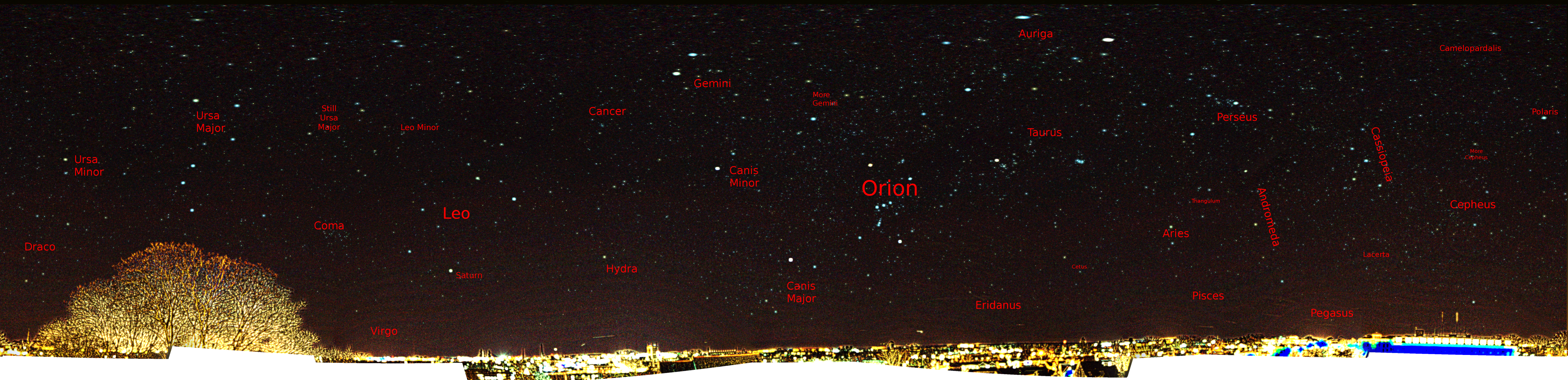
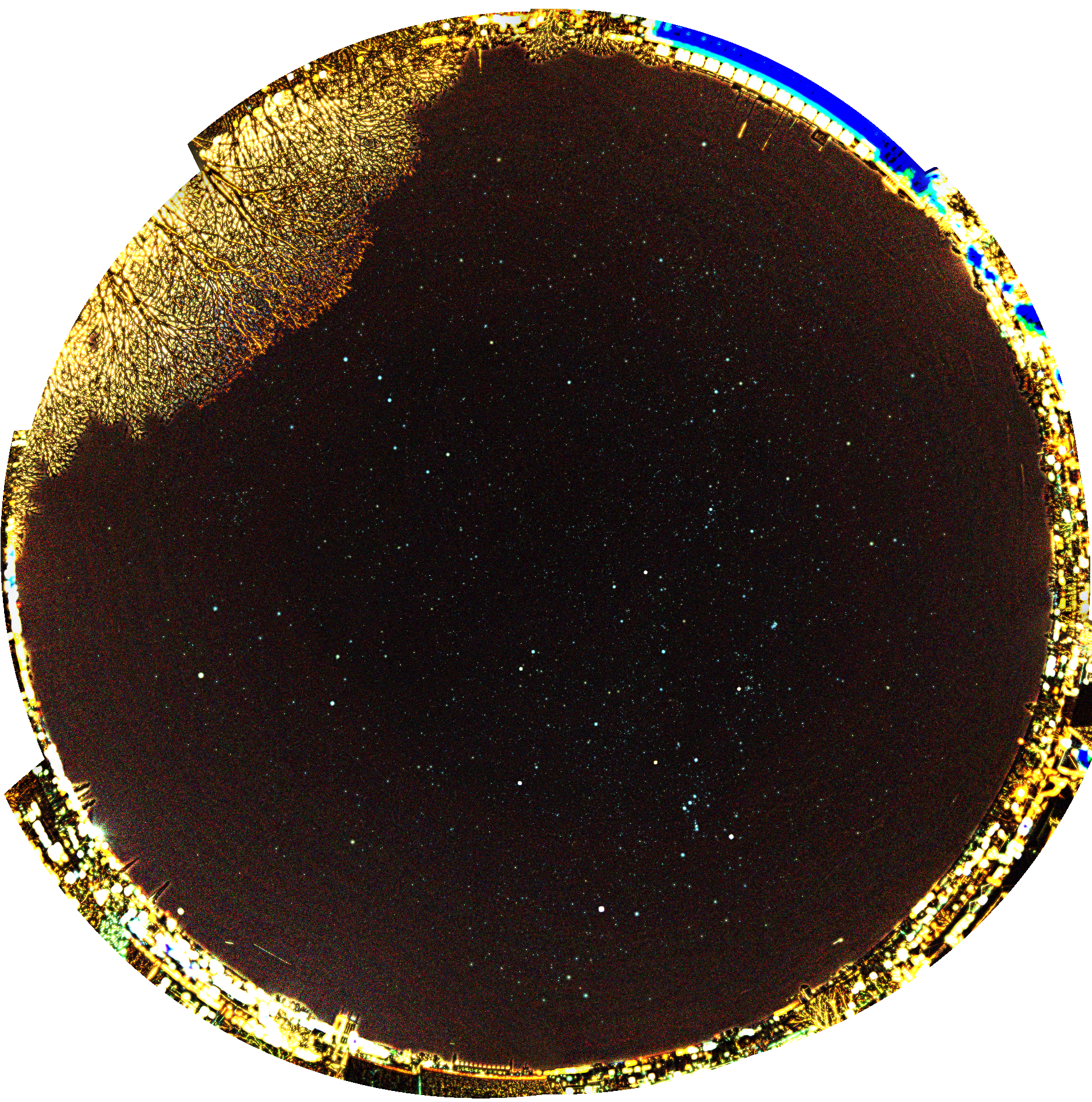
A two-step process here. The glare from the street-lights is fairly smooth whilst stars are fairly point-like, so in particular, if you take a square out of the image and line up the pixels in it by brightness, the middle one (the median) will almost certainly not correspond to a star, and will be probably a good estimate of how bright the street-light glare is for that square. So if for every pixel you consider the square around it, find that median brightness and subtract it, you've basically cut out the glare. Note from the image above that this treatment makes anything which isn't smooth glare with pointlike stars in it look Very Strange Indeed.

If you just apply the de-glaring process, the next problem is that bright stars look just the same size as faint stars; if you increase the overall brightness of the image so that the faint stars are visible, all stars above a certain brightness look like small white spots, and you can no longer see the constellations outlined by their brightest members.

To fix that, I've blurred the image, so that bright stars turn into large reasonably-bright blobs and faint stars vanish, and added the blurred version to the original to restore the faint stars. The result's pretty garish, but representative in three ways: bright stars are visibly prominent, the colours of the bright stars are about right, and (checking against an online star atlas) the faintest stars you can see in the image are pretty much the faintest stars that you could see with the naked eye were the town around Castle Hill to be replaced by unilluminated desert.

Here is the C++ code (requires libtiff, and I think I'm missing some important attribute so you have to do some no-effect transformation like mogrify -modulate 100 output.tiff to turn the TIFF file into one that the hugin panorama-making software can read).

Of course, once you have the data in a panorama program, there are various things you can do with it:


fivemack: (Default)
The path from the back gate of the garden to the back door of my house is a single line of trampled grass and mud. Mostly mud, this time of year.

Having dug a very large hole in one of the beds and half-way across the path to remove a tree-stump obviously doesn't help, the packed earth is converted into loose earth which turns rapidly into the finest grade of mud.

Is there any good way of keeping this from happening? It's a rented house so I'm not willing to spend very much on things like gravel; are there decent matting materials that I could get at reasonable price and just unroll across the garden, or would that be expensive, ugly and ineffective? The grass is already pretty ruined so I wouldn't mind too much about matting killing the grass under it, but I'd want matting that would survive a couple of years unloved outdoors.

With about half a cubic yard of builder's sand, a couple of square metres of paving stones and a quantity of plastic liner, which looks like about a hundred pounds in cost, plus a large amount of healthy shovelling and rolling, I could actually build a proper path of paving stones laid on sand; maybe this is something to discuss with the landlord.

March 2024

S M T W T F S
     12
3456789
10111213141516
17181920212223
24 252627282930
31      

Syndicate

RSS Atom

Most Popular Tags

Style Credit

Expand Cut Tags

No cut tags
Page generated Jan. 31st, 2026 10:21 am
Powered by Dreamwidth Studios