fivemack: (Default)
Imagine my shock to discover that Paris in the spring-time is in fact pretty much as nice as it's advertised to be. I'm in a hotel at the bottom of the butte de Montmartre, so I walked up to Sacre-Coeur, walked from there to Notre-Dame, visited the Sainte-Chapelle, walked along the Seine to place de la Concorde to have tea at Ladurée (the shop that invented the macaroon), then back to Montmartre to stuff myself to a truly ridiculous degree with cassoulet.

La Madeleine struck me as a church designed by somebody who'd rather be designing a secret-police headquarters; it's a Greek temple without the setting, very four-square and bleak from the outside.

Have I just not noticed the parts of English towns with green copper roofs, gilded statues, and the name of the building carved inches deep and picked out in gold leaf, or is that an architectural style incompatible with English weather?

Tomorrow, Afghan gold, the Arc de Triomphe and La Defense, and possibly Pierre Hermé's patisserie; I've heard him described as the Heston Blumenthal of the cake world, which would probably be enough to draw me to Paris on his own. The Bulgarian-treasures exhibit advertised on Eurostar has unfortunately already moved to Basel, the unannotated date on the document was the closing date not the opening date.
fivemack: (Default)
1)Where's the best place you've visited?

I think that probably has to be Romania; certainly, when I close my eyes and think about holidays, I seem to be thinking of Peles castle in Sinaia. It's a combination of the slight extra intensity you get by travelling on your own on Eastern European trains where you can just barely speak the language, that I managed to meet four memorably-interesting people in a week (the infinitely erudite American aid-worker, the perfectly-cynical perfectly-Anglophone trainee lawyer on the train from Sibiu to Bucharest, the specialist in removing wrecks from the Danube who was staying at the Bucharest youth-hostel, and the young doctor desperately looking for a way out to somewhere where a doctor's pay was sufficient to afford the drugs to treat her leukaemia), and the unreasonably Heidi-like greenness and Swiss-cottageness of Carpathian meadows.

2)What's your favourite comic?

I'm verbal and unobservant enough that comics really aren't my thing; I've followed instructions and read The Dark Knight Returns, Watchman, V for Vendetta and bits of Sandman, but all out of a sense that culture required me to read them. Of those, I think I missed the point of Watchman.

Misunderstanding the question, Harry Hill; political comedy I find actively painful because I think of it as taking things that ought to be fought over and annihilated, and going the cheap route of mocking them.

3)Would you ignore OU course entry requirements and just do the course anyway?

For a science course, I probably would; I'm arrogant enough to believe that I can pick up bits of background with Google and a library, and that reading New Scientist since the age of seven ought to have got me an eighth of an inch of background in almost anything.

Moderately Advanced Korean, requires Basic Korean, I'd not try to blag; science is easy and tonal languages are hard.

4)What's your favourite thing about crystallography?

I like the way that, pace all the quantum people, you can see atoms as little blobs [yes, I know these are normal-distributions of thermal motion], and that all the stuff you learnt in chemistry with balls on sticks is, at at least one practically-useful level, really true.

5)What did you think of the eclipse?

I thought the sky-gods had been particularly good at the composition between the legs of Leo, and the air-gods particularly kind in keeping the sky cloudless; but I didn't have binoculars or a camera with me, and lack the patience to sit and observe. It was a nice shade of orange. I was with friends in Hull; we'd watch eclipse until cold, go inside and play Jenga, watch more eclipse, go inside and dance wildly to Robbie Williams, watch more eclipse, ...

I wonder if anyone's done a good model of what the view of Earth from the Moon would be during a total lunar eclipse; presumably a black disc with a brightly-backlit orange-to-red ring of atmosphere around it, and with good binoculars you could see city lights in the night.


If anyone wants to be questioned by me, ask in comments.
fivemack: (Default)
I have on my desk the replacement for the computer I bought at the start of the year which exploded three hours after purchase.

I've had it for not quite a week. It persistently crashes, apparently sometimes corrupting parts of the hard disc, when I give it certain fiddly disc-intensive calculations to do. Sometimes it crashes under other circumstances. Is Ubuntu 6.10 known to be this irredeemably unreliable on contemporary Intel hardware, or have I just received my second lemon in an order of two?

It's running memtest86 overnight, but no faults have shown up yet; I suspect this is a disc-controller rather than a memory issue, and no faults will show up. The last memory issue I had -- a module which had an unshakeable faith that every 1024th bit in the memory it presented had to be reported as zero whatever had been written to it -- showed up immediately in memtest86.

Is there a disc equivalent of memtest86? I'm prepared to take backups of everything - there's not much novel, I've only had the machine a week - and sacrifice the disc contents should the test need to be destructive, though I'd prefer something that sat in userspace and confined its merciless thrashing to the bits of the disc on which my data isn't.
fivemack: (Default)
I write from the palatial lobby of the Diamond Light Source administrative building, on day three of the meeting of the BIOXHIT project. This is a four-year project on bioinformatics and improved software and hardware for handling synchrotron radiation; it's my first exposure to EU project management. Rather over a hundred people here, among whom I'm very junior; something like fifteen million Euros over four years coming from the project.

There's a large contingent from EMBL Hamburg here, so on every other coffee-table the language of conversation is German ... a German-speaking Englishman is unthinkable, so the North Germans assume I'm Swiss and the South Germans assume I'm Dutch. This pleases me.

The food's very good, which always makes me feel slightly guilty for an EU project; there is one EU budget, every eurocent we spend on too much wine is a eurocent not available to the Plovdiv-to-Ploesti motorway project. And whilst understanding ammonium metabolism in E.Coli or running three parallel projects to design crystallisation robots and two parallel software packages to recognise crystals in images is clearly useful, I'm not sure I'd wish to justify this over the motorway project to Mr Alexandrescu in his broken-down van on the Bulgarian border.
fivemack: (Default)
Elizabeth Moon, Winning Colours. Third in a series of Ruritanian space-operas, combining somehow the traditions of planet-spanning military fiction with the dramatic conventions of the Famous Five. Almost all problems are resolved by the intervention of powerful relatives. Fluffy comfort reading; third in a sequence of apparently six, though I'm warned off numbers 4 and 5.

K J Parker, Devices and Desires. An unusually-smart engineer is wronged by the government of his city-state, who have secured dominion over the world by jealously guarding the secret of Mass Production. His plan to get back to his family is a Heath Robinson machine with armies and kings as its components. Told through the eyes of a series of nicely wry narrators.

Elizabeth Moon again, Speed of Dark. Told by an autistic narrator, who struggles gently with the world but manages mostly to get by; let down by a peculiar ending and an unreasonably evil villain with a lack of self-awareness enough to embarrass me through the pages. I'm not keen on autistic narration - The story of the dog in the night-time I found unreadable - but this worked better.

William Manchester, American Caesar. Somewhat hagiographic biography of Douglas MacArthur, a character whose ubercompetence and impossible manner one would think over-done in a work of fiction. This is bits of history that I hadn't really encountered before: the First World War from the American point of view, the Pacific War - I really hadn't realised how much of it took place in New Guinea, or of what scale the Japanese forces in random Pacific hells were - the occupation of Japan and the war in Korea. Very interesting.

Stanislaw Lem, Imaginary Magnitude. This one's amazing; the conceit is that it's a collection of prefaces to future books, the first half is a collection of wonderful big-idea short stories, and the second a solid approach to the philosophical problems posed by superhuman artificial intelligences. Makes most science-fiction writing seem childishly basic, there's a sort of sharp, precise competence to it.

Larry Niven, Protector. Fun to read, and must have been great fun to write; this is an alien-contact story coupled with a mastermind-driven heist tale. I have a very odd angle on Niven, after reading Tales of Known Space, a collection of short stories and of descriptive writing about his Known Space setting, before actually reading any Known Space works.

George R R Martin, Fevre Dream. If you want pre-Civil-War Southern decadence, with hot humid forests, the romance of the river-boats, violence, slavery and vampires, this is the book for you. Definitely good.

R A Macavoy, The Belly of the Wolf. This one's more difficult to describe: what I like of it is the extremely calm style of the writing, I can't now recall the sequence of events at all.

Karl Schroeder, Sun of Suns. Another fun one, a picaresque set in floating cities, illuminated by their own petty nuclear suns, inside a floating spherical world with a great nuclear sun at the centre and where the water-vapour freezes into iceberg-sized icicles at the edge. You get the impression that the author has run the climate models to see how the clouds would behave and how the trees would grow, and then decided to set the action for his own amusement. Feathered fish, air-pirates, and Sargassoes of the sky.


Do any of my readers wish to borrow any of these (Devices and Desires is already lent out); can anyone suggest books I'd be interested in reading given what I thought of these ones; does anyone dispute my reviews?
fivemack: (Default)
It was a gorgeous day today, and I went with my parents to Minsmere (the collection of artfully-shaped swamps and heaths here, just up the coast from Sizewell; don't reed-beds look odd in satellite images?). It felt as one would expect unmodified ground to, though the satellite picture makes it clear that it's as managed as any stately-home garden.

At one stage I left the camera on entirely the wrong exposure settings, so shot a sequence of deeply overexposed frames of a flying seagull: obviously most of these were junk, but one was really quite striking:


Click for more birds )
fivemack: (Default)
Moon pictures really do benefit from using the telescope:


Earlier Moon under cut )
fivemack: (Default)


I think, for a usefully peculiar news perspective, I'm inclined to recommend chinadaily.com.cn even over english.aljazeera.net. Lots of entertaining Kremlinology (presumably should be Zhongnanhaiology, but that's not exactly a catchy word) to be done on what topics are permitted to be portrayed in the offensively-harmless cartoons. Also, baby pandas.
fivemack: (Default)
The Sichuan Wolong Panda Centre, having finally figured out how to artificially inseminate pandas reliably, is now overrun with baby pandas.


The only problem is that Bayes's Theorem, plus the strong resemblance between baby pandas and toy pandas, means your first seven or eight thoughts are 'why are these serious-looking Chinese scientists posing with sixteen toy pandas?'

PS: additional baby pandas here, baby polar bear here ... I notice that China Daily has rather more cute baby animal photos than serious Western papers tend to.
fivemack: (Default)
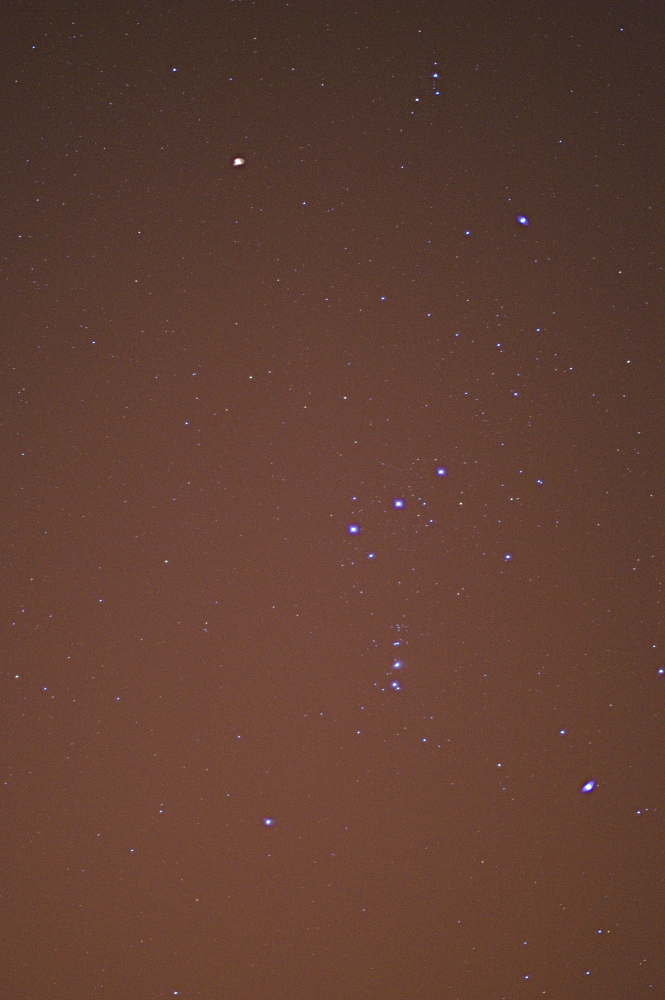
On the other hand, one gets better results hacking at roots with an axe than with the edge of a spade, and a bowsaw cuts a lot better than the little rip-saw on your Swiss army knife ... I picked up a 50/1.4 lens on ebay, older than me and of a build quality suggesting it could shrug off light artillery fire, and a quick set-up on Castle Hill gets me pictures like this

(666x1000, so I haven't embedded it, and shrinking it rather loses the clouds-of-stars effect).

I'm imaging from the top of Castle Hill stars that the most eagle-eyed couldn't see with the naked eye from the top of Mauna Kea ... the sodium glare is the limiting factor now. Also the tripod shakes slightly in the wind, but this can be avoided by waiting for a clear night when there's no gale blowing.
fivemack: (axe)


Took about two hours in three sessions, quite a lot of digging, the use of both (borrowed; thanks [livejournal.com profile] rmc28) axe and mattock, and some blisters on my hands; I'm very thankful that leylandii don't have tap-roots, I'm not sure what I'd have done in that case.

Now all I have to do is fill in the hole where the stump was, and I'll never trip over it again. Is rotting wood a good fertiliser?
fivemack: (Default)


Half past midnight on Friday, looking west from the top of Castle Hill; New Hall in the bottom right-hand corner, the Pleiades at the top, Aries and Triangulum in the centre, Andromeda at the right, Cetus and Pisces in the bottom left ... a region of the sky that, even if you could see through the glow, would have little defence against being described as small boring groups of faint stars. The glow left of centre at the bottom is probably St Neots.

The ability to get at midnight to somewhere that the sky is reasonably dark is really the only incentive to learn to drive that my current lifestyle gives me; the sets of my friends with cars, with interests in astronomy, and without sole care of a small child have I think no intersection. I'm not even quite sure where to go: Cambridgeshire, whilst well-endowed in so many respects, has few isolated steep unwooded south-facing hills with convenient road access. Not that I got up many of those when in better-so-furnished Gloucestershire.
fivemack: (Default)
Enlivened by the comet, I went up Castle Hill again, with my birding lens and nice new tripod.

After one or two bits of infrastructure-building - figuring out the format of the sensor-data part of Nikon's .NEF files (the last 9728000 bytes of the file contain 2000 lines, each of 3040 samples packed as 304 16-byte chunks, with each chunk containing ten 12-bit numbers packed two-in-three-bytes as 0xAA 0xAB 0xBB and a final 0x00) and implementing dark-field subtraction because the D100's sensor, especially at high ISO, is plagued with hot pixels, I got some reasonable shots.

The Hyades cluster in Taurus; Aldebaran bottom left


The problem is, the star images are big and ugly. I'd calculated, based on a pixel size of 7.8 microns, that a star would move three pixels in a 1.6-second exposure at 170mm, or one pixel in a 0.3-second exposure at 500mm. I'd noticed that it took a while for vibrations in the tripod to settle, so used self-timer to let it settle before taking the shot. But still a star at 500mm is fifteen pixels across on the 0.3s-exposed image. Seeing in Cambridge isn't great, but it's not likely to be as dreadful as 45 arc-seconds.


My guess is that I'm not focussing correctly. But I'm not sure how I focus correctly; there's no light, so auto-focus just hunts back and forth and gets nowhere, turning the focus dial until it hits the infinity end-stop doesn't seem to be sufficient; my eyes can't distinguish a perfectly-focussed star from a slightly out-of-focus star. Towards the end of the session, taking photos pointed pretty much straight up with the lens at 500mm, I was getting images trailed by movement of the tripod rather than the stars, but that's more a matter of waiting for a season where the interesting object isn't at the zenith.

[ For taking pictures of stars, I think the figure-of-merit is focal length / f_stop^2; the permitted exposure before the motion of the stars blurs them is proportional to 1/focal_length, and the amount of light that gets in is proportional to the lens area = (fl/ap)^2. For star-fields, it's 1/(fstop^2 * focal length), since the area of sky you see, and so the number of stars, is proportional to 1/fl^2. 50/1.4 lenses are what this measure tells one to lust after ]
fivemack: (Default)


This is comet 2006/P1 McNaught; it's appeared rather unexpectedly, and you can see it very close to the western horizon around sunset, about ten degrees to the right of Venus, until about Sunday - I went to the top of Castle Hill at 5:10 for this shot (after excitingly summoning the whole company!), and it had nearly set.

[ISO1000, 10 seconds, 200/5.6, cropped and brightened in gimp for top one, unaltered below]

fivemack: (Default)
Is there anyone reading this who lives in Cambridge.uk, owns an axe, and would be willing to come round for a few minutes one evening and chop through a number of rather solid tree-roots (several about as thick as my arm, and one about as thick as my calves) for me? I will cook them curry, or something other than curry if they'd prefer, in return.

This seems the right time of year for major garden-fettling, since the annuals from last year are dead and I haven't got round to planting anything in the large areas which are getting covered in earth as I try to dig out the least conveniently-placed of the three tree-stumps with which earlier renters have gifted the garden. The house came with 45 large brown bricks in a pile, which I think will make a good path down the middle of the back bit of the garden, but the tree-stump is inconveniently in the way.
fivemack: (spiky)
I received an unexpected Christmas bonus this year, and bought a computer with it; as usual I ordered it as parts, and they arrived this afternoon.

It all went together fairly easily - SATA cables avoid the problem of wrestling with two-inch ribbon cables, the chip fits neatly into the socket, the Intel heat-sink attaches by simply pressing down push-pins, and on the whole it very much betrays the enormous effort that's been put into making computer assembly an occupation in which a Chinese former rice-farmer can be productive within the week.

The software, however. Intel's designers assumed, when they started designing this chipset a couple of years ago, that there would by now be no parallel IDE devices. Taiwan's low-cost manufacturers of CD-ROM drives noted that their devices didn't need SATA and would be made ninepence more expensive by incorporating them, so CD-ROM drives are parallel IDE devices. So motherboards need to have parallel IDE support even though Intel's integrated chipsets lack it. The cheapest form of parallel IDE support is a chip by Marvell. This chip is not supported by any operating system's install disc.

So you can try to install an operating system, and it will think for a few seconds, and then declare that the CD-ROM drive that it was loaded from doesn't exist, before vanishing in a puff of logic.

There is a way round this - you copy the CD onto a memory stick, basically. There are an unreasonable number of painfully exact refinements required before the process works, including three things which you have to get right without any diagnostic message if you get them wrong; http://www.chiark.greenend.org.uk/~twomack/DG965WH.txt lists the necessary process.

I'd got about 90% of the way through the install before getting strange failures; it emerges that there are two areas of memory on my memory stick where, if you store some number, it reliably reads back an entirely different number; amongst other things it has a violent dislike of odd numbers, a strong fondness for exact multiples of sixteen, and a total disdain for all numbers between 239 and 255 inclusive. Unsurprisingly, operating systems are confused by this; Ubuntu very kindly does careful integrity checks on the files it's trying to install, so the result's a clear error message rather than a subtly broken operating system.

It is only from a suspicion that the memory stick might be within warranty, and my regrettable lack of a fourteen-pound lump hammer, that I have not released my frustrations on it with a fourteen-pound lump hammer.


Half an hour ago, as I was sitting with the computer turned off on the desk next to me, there came a large white flash, a bang, and a strong smell from the power supply unit. I am told that I'm entitled to send the whole assembled system back and ask for a refund; probably the right thing to do, one loses a certain amount of confidence in a device once it's exploded once.
fivemack: (Default)
New Year's Day is a foolish time to froust — it might become a habit — so, having recovered from discovering the strange cephalopod carved into what was purportedly the Maize Maze behind a children's play area in Fulbourn, I planned a route through Cherry Hinton to Fulbourn, Balsham and Little Abington, and thence to the Gog Magog Hills, where various people were flying kites.

Some inconsiderate deity had added a number of hills between Fulbourn and Balsham — I suppose in retrospect that the name 'Gog Magog Hills' might have provided a hint — so this was rather more energetic than I'd expected. Flying a tame and well-behaved kite is surprisingly meditative; you stare up at this little square in the sky, and tug one hand to turn it one way, the other to turn it the other. With the wind as it was on Monday, the tame kite sits of its own accord, mildly exercising your shoulders.

Some people had brought rather wilder kites: click on the photo below for more pictures, and for the flock of geese which it is moderately alarming to find in the road after a blind corner descending a steep hill.


fivemack: (Default)


(SLC is the Student Loans Corporation; I have not suddenly become an inadequately-tithe-paying Mormon)

Read more... )

March 2024

S M T W T F S
     12
3456789
10111213141516
17181920212223
24 252627282930
31      

Syndicate

RSS Atom

Most Popular Tags

Style Credit

Expand Cut Tags

No cut tags
Page generated Feb. 2nd, 2026 09:08 pm
Powered by Dreamwidth Studios